A multidisciplinary Quality of Care Path for couple infertility: development of an integrated approach founded on a multidisciplinary, personalistic, and ecological model for couple fertility
Giuseppe Grande1,2, Walter Colesso1, Stefano Gava3, Umberto De Conto4, Mario Cusinato1.
- Fondazione Centro della Famiglia, Counseling center, Via S. Nicolò 60, 31100 Treviso (Italy);
- ULSS2, “S. Valentino” Hospital, Via P. Togliatti 1, 31044 Montebelluna (TV Italy);
- ULSS2, “Ca’ Foncello” Hospital, 31100 Treviso (TV Italy);
- ULSS2, Family Doctor, 31030 Breda di Piave (TV Italy)
Contact Author:
Giuseppe Grande
Address: “S. Valentino” Hospital, Endocrinology Clinic, Via P. Togliatti 1, 31044 Montebelluna (TV), Italy
E-mail giuseppe.grande@aulss2.veneto.it
Abstract
The Path of Fertile Family (FFP) is a service for couples experiencing infertility, aimed to obtain natural conception, as an alternative to assisted reproductive techniques, developed in 2018 and provided by the Counseling Centre of Centro della Famiglia Foundation, an institute of culture and pastoral care of the Diocese of Treviso, in cooperation with the local socio-health unit. FFP offers to infertile couples a specific multi-disciplinary path of care, including the involvement of specific gynecological, andrological, endocrinological, and psycho-relational competences, together with fertility awareness. It represents an “experiential laboratory” for the multi-disciplinary diagnosis and treatment of infertility, for understanding relational processes, for the development of operational strategies and above all for the verification of the goodness of a lifestyle that is able to harmonize the couple’s project and the family’s project, couple satisfaction and parental openness.
The setting of the service draws inspiration and reference from three paradigms from which significant ethical choices derive: the ecological perspective of fertility, the relational intimacy of the couple and a multi-disciplinary approach. From the three founding paradigms, FFP model has been developed and progressively implemented in order to define a specific FFP Quality of Care Path (QCP) for couple in-fertility.
Although further studies are needed to better clarify the role of each studied variable in a complex monitoring system, we identified for the first time a QCP Path based on 7 variables we present here two illustrative cases: the first one in which a natural conception has been obtained and the second one, in which the focus has been moved from natural conception to the reconstruction of relational competence. Further studies will demonstrate, on large scale, the efficacy of our protocol and of the analyzed variables.
Summary
This paper provides an overview of the conceptual and methodological process of implementing the monitoring of the path of infertile couples towards natural conception in harmony with their relational life project. A multi-professional team accompanies couples in overcoming the obstacles to fertility and in the progressive awareness that parenting is not only biological. The result is a range of goals to strive for. The reference paradigms of the service justify the ethical choices of the couple and the team. The operating protocol supports the couple commitment and guides professionals in their effective action if competent and concerted. The variables identified are the monitoring tool that gradually indicates the degree of the path progress.
Keywords: Fertile Family Path, Infertile couple, Infertility, Natural conception, Fertility awareness, Relational competence, Multi professional team, Monitoring dimension
Introduction
Couple infertility, defined as the lack of conception after at least 12 months of regular unprotected sexual intercourse aimed at pregnancy (Zegers-Hochschild et al. 2017) is a common clinical condition. About 10% of couples in the world are infertile with 56% of them seeking medical care (Boivin, Bunting, Collins, and Nygren 2007). Assisted Reproductive Techniques represent often the first line treatment for infertile couples (United Nations 2017). However, they are associated with low percentages of success (Stanford, JB 2021), medical problems for offspring (Rumbold AR et al. 2019) and eth-ical problems related with embryo production and loss.
The Path of Fertile Family (FFP) is a service for couples experiencing infertility, aimed to obtain natural conception, as an alternative to assisted reproductive techniques, de-veloped in 2018 and provided by the Counseling Centre of Centro della Famiglia Foundation, an institute of culture and pastoral care of the Diocese of Treviso, in coop-eration with the local socio-health unit (Cusinato M, Colesso W, Busato E, Gava S et al. 2021). FFP offers to infertile couples a specific multi-disciplinary path of care, in-cluding the involvement of specific gynecological, andrological, endocrinological, and psycho-relational competences, together with fertility awareness.
FFP is rather a niche work. It represents an “experiential laboratory” for the mul-ti-disciplinary diagnosis and treatment of infertility, for understanding relational pro-cesses, for the development of operational strategies and above all for the verification of the goodness of a lifestyle that is able to harmonize the couple’s project and the family’s project, couple satisfaction and parental openness. Briefly, FFP matches the Glossary on Infertility and Family Care (2017) definition of “fertility care”: “Interven-tions that includes awareness, support and fertility management with an intention to as-sist individual and couples to realize their desires associated reproduction and or to build a family” (p. 1793).
We previously reported the existence of this new fertility clinic in Treviso, Italy, that represents an alternative to Assisted Reproductive Techniques (Cusinato, et al., 2021).
The aim of this study was to develop, for the first time, a specific Quality of Care Path (QCP) for a holistic multidisciplinary treatment of couple infertility, useful for monitoring the efficacy of this new approach. Furthermore the 2 illustrative cases are reported, to confirm the efficacy of this QCP.
Background of ethical paradigms
The setting of the service draws inspiration and reference from three paradigms from which significant ethical choices derive: the ecological perspective of fertility, the relational intimacy of the couple and a multi-disciplinary approach.
Ecological perspective of human fertility
Ecology studies the relationships between man and the environment (Wyrostkiewicz 2013). An ecological vision of human fertility is therefore an area that deserves attention. It is fascinating to note that fertility represents the predisposition of an “internal”, anatomical and physiological environment, to welcome the son, thus providing for the nourishment and protection of the embryo and fetus. At the same time, an “external environment”, mainly represented by the affective, psychological, relational, structural, organizational, territorial, and social dimensions, plays a key role both to create the conditions for conception, and to its care and care (Cavasin and De Conto 2021). An ecological approach to fertility therefore means attention to the complex relationships between these internal and external environments. We could further expand the environmental dimension by considering not only the individuals involved, but also their emotional and cultural backgrounds, that intangible components that play a role the context in which fertility is realized and completed (Morse and Steger 2019). In this perspective, we have to consider moreover both anatomo-physiological fertility and all the factors directly or indirectly influencing couple fertility, including the complex network of relationships. This complexity can only be taken into consideration by articulated and multi-professional teams, aimed to integrate knowledge and skills within ecologically “complex” operating units. An approach to infertility based on integral ecology means to develop paths of care based on the centrality of the persons and of the no relationships, avoiding standardized treatments, in a real perspective of personalized medicine (Benazzi 2021).
The relational competence
Relational motivations had a special value in the design of FFP service. Although a current individualistic mentality, the relational perspective represents a challenge with well-founded reasons and is strengthening in many scientific disciplines: neuroscience (Berardi and Sale, 2018), philosophical reflection (Vigna and Zanardo 2005), social research (Donati 2015), socio-political research (Zamagni and Scaco 2006), theory of social organizations (Moscatelli 2013), psychology of human relations (Cusinato 2021), narrative medicine (Dal Pozzo and Dal Pozzo 2021), ethical instances (Sesta 2021).
Due to the psycho-relational implications of FFP, the theory of relational competence is the reference paradigm that offers a plurality of hierarchically and empirically verified and testable integrated models (L’Abate et al. 2010). Relational competence explains the construction of personal identity and the functionality of intimate relationships in the relationship between “agentic power” and “communal power” (L’Abate 2013).
Starting from these models, a specific representation of the relational competence of the couple was developed, representing the basis for the psycho-relational monitoring the service. Life, as a couple, requires the continuous activation of two powers: ability to negotiate – expressed in the plurality of everyday relationships in terms of doing and having – and ability to love. In a synthetic way it can be said that the first capacity supports the tension towards differentiation and individual recognition, while the second one to develop the “us as a couple”. However, the first one cannot be realized without the second one and vice versa, since one is the background of the other, in a continuous “focusing game”, which depends to circumstances, life situations and needs.
The multidisciplinary approach
A multidisciplinary approach to care involves the interaction between different professionals, called to respond to specific and complex needs, by going beyond each specific scientific skills and starting to think about the person as a whole. A multidisciplinary team is made up of various specialist doctors with particular knowledge and skills regarding the various aspects of complex pathologies and has as its primary objective the integration of the various professional figures and the sharing of the diagnostic and therapeutic path in all its stages. It has been demonstrated that the shared management of the patient by a team allows for a more efficient and effective approach of care (Roncaglia 2011), in many field including oncology (Kesson et al. 2012). This approach improves moreover the patient’s perception of well-being (Davis et al. 2012), both directly by reducing anxiety and depression, and indirectly by promoting trust and social cohesion. The results of a more intense communication between the patient and the care team, a fundamental element of patient-centered care, have been studied in many researches, thus demonstrating the improvement of the quality of life and the reduction of costs for a multi-disciplinary therapeutic intervention (Benazzi 2019).
This kind of approach is particularly important when considering a complex situation such as couple’s infertility. A significant experience in this area is offered by the “Paul VI” International Scientific Institute (ISI) at the Foundation Polyclinic “A. Gemelli”, where it has been developed, since 2003, a multidisciplinary protocol for the diagnosis and treatment of infertility, involving a team composed by gynecologist, endocrinologist, andrologist, and fertility awareness practitioner.
Starting from these premises, and according to the other paradigms of our model, in the FFP service a specific protocol for diagnosis and treatment has been developed, by the involvement of a multidisciplinary team composed by gynecologist, endocrinologist, andrologist, fertility awareness practitioner, and psychologist (Cusinato and Girotto 2021).
Implementation of the FFP Model: Definition of a specific QCP
From the three founding paradigms, FFP model has been developed and progressively implemented in order to define a specific FFP Quality of Care Path (QCP) for couple infertility. QCPs have been adopted by the health systems of many States because they guarantee the appropriateness and quality of health services and establish performance, times, outcomes and verification of the processes and of the outcomes (Sermeus et al. 2005). In the area of infertility however no specific QCPs have been produced, although specific multidisciplinary guidelines have been proposed by Scientific Societies (Ragusa 2016-2021). Taking into account all these information, we tried to develop a specific multidisciplinary protocol for infertility, with times and outcomes, thus defining the verification processes of the QCP. Seven dimensions have been identified and operationalized by Likert scales at six levels of functionality: three medical, three psycho-relational, and one of life satisfaction.
Female infertility
A female factor is responsible, alone or associated with a male factor, of 55% of infertility cases. A plethora of systemic and gynecological conditions can affect the female reproductive system and potentially lead to infertility, including ovulatory dysfunctions, infections, endometriosis, tubal diseases (Deshpande and Gupta 2019). Besides organic diseases, lifestyle factors such as an unbalanced nutrition and unhealthy diet may interfere with the physiological reproductive functions in women (Masoumi et al. 2015).
The most common cause of female infertility is ovulatory dysfunction. Ovulatory disorders account for approximately 25% of infertility diagnoses; 70% of women with anovulation have a Polycystic Ovary Syndrome (PCOS, Carson, and Kallen 2021). Such a syndrome is a multifactorial disorder and is characterized by a combination of clinical (anovulation and hyperandrogenism), biochemical (excessive androgen and luteinizing hormone concentrations) and ovarian morphological (polycystic ovaries) features (Rotterdam ESHRE/ASRM-Sponsored PCOS Consensus Workshop Group 2004). Other common causes of chronic an ovulation include endocrine diseases, including hyperprolactinemia thyroid disease or secondary hypogonadism.
Infections of low genital tract can induce infertility both directly, inducing a structural and functional change in cervical mucus (Grande et al. 2015) and in endometrial receptivity (D’Ippolito et al. 2008), and indirectly, since ascending infections represent the cause of Pelvic inflammatory disease (PID), affecting the uterus, fallopian tubes, and/or ovaries (Abrao, Muzii, and Marana 2013).
Among the infertility causes, endometriosis is a chronic gynecological inflammatory disease characterized by the presence of functional endometrial glands and stroma outside of the uterine cavity. It affects 7–10% of women of reproductive age and up to 50% of women with infertility (Meuleman et al. 2009). Although the pathophysiological mechanisms of endometriosis have not been completely explained, several data demonstrated that endometriosis is characterized by a systemic inflammatory pattern and the role of impaired natural immune system in endometriosis (Grande et al. 2017). Depending on the spread of this ectopic endometrial tissue, four stages of disease are distinguished. Endometriosis often causes sterility due to severe tubal adhesions with consequent occlusion. In the ovary, if present, it causes oxidative damage with consequent alteration of follicular and oocyte function. Therefore, passing from mild to more severe forms of endometriosis, the possibility of spontaneous conception is progressively reduced, passing from a probability of 60% in the minor stages to about 5% in the more extensive forms. In the FFP QCP, all the major biological factors on fertilization (endocrine-ovulatory, utero-cervico-vaginal, tubal, and endometriosis) are evaluated and – when possible – treated by medical therapy or surgical intervention.
To monitor the outcomes of treatment over time, a table was developed regarding each of the four negative biological factors on fertilization (endocrine-ovulatory, utero-cervico-vaginal, tubal, and endometriosis) specifying diagnostic assays, diagnosis and therapy (Marana, Busato, et al. 2021, work in progress). This arrangement, although provisional, offers a guide for medical history collection, diagnosis and time control.
Male infertility
A male cause can be identified in 25-50% of couple infertility cases; it can be isolated or in association with a female factor. Semen analysis is the cornerstone for the assessment of the male partner in an infertile couple. The test has been standardized throughout the world thanks to the World Health Organization (WHO) efforts, which, since the1970s, has produced, edited, updated, and disseminated a semen analysis manual. The latest edition is recent (WHO, 2021). However, the andrological evaluation cannot be limited to a mere standard semen analysis. A complete diagnostic and therapeutic approach is mandatory in the clinical workflow for male infertility (Grande, 2021; Milardi, 2021).
First of all, we must underline the fundamental role of a proper medical history collection and a complete physical examination, as they provide essential information to the clinician: physical examination, for example, provides crucial information on testicular volume, the presence of palpable cysts or epidydimal alterations, the presence of a varicocele. The diagnostic flow-chart aims at identifying (and treating when possible) the diseases more frequently associated with male infertility: infectious/inflammatory disease of the genital apparatus, endocrinological diseases (hypogonadism, hyperprolactinemia, thyroid disease) and varicocele.
Starting from seminal parameters, and in relation with the diagnostic flow-chart, we defined a scoring system to be used for monitoring male infertile patients during the diagnostic and therapeutic workflow.
Fertility awareness
Fertility awareness has been defined in the International Glossary on Infertility and Fertility Care: “the knowledge of reproduction, fecundity, fertilization and related individual risk factors (e.g. older age, sexual health factors such as infections sexually transmitted and lifestyle factors such as smoking and obesity) and non-individual risk factors (e.g. environmental and workplace factors); including awareness of the social and cultural factors influencing options for fulfilling reproductive family planning as well as family building needs ” (Zegers-Hochschild et al. 2017). This definition suggests that this is a global commitment that should be considered by doctors, health professionals, researchers and policy makers.
In fact, recently, Peterson and Place (2019) define awareness of fertility in the three levels of prevention: primary, secondary and tertiary (pp. 29-31). In the context of the FFP service, the tertiary prevention strategies have been considered: “to help people to manage appropriately or improve their health status in the long term” (p. 31). Fertility awareness, in our perspective, means as a consequence “to know and recognize when the fertile period occurs in the menstrual cycle”.
The recognition of the fertile period has for decades been the subject of teaching/learning from the different methods of natural family planning (NFP), so that natural fertility planning and fertility awareness are often comparable in the literature even if conceptually different (Obeleniené, Narbekovas, and Juskevicius 2021). In our QCP the two terms overlap, since the couple’s commitment to identify the fertile period – particularly useful for the timing of the relationship or for the timing of specific investigations – represent an “open window” to make informed decisions on the management of reproductive and sexual health, of the generative project, and above all to improve the relational intimacy of the couple, according to the mentioned reference paradigms.
Fertility awareness in our protocol means: the ability to identify the fertile window in its signs of temperature, cervical mucus, mucus peak, indication of the days of maximum fertility; collaboration as a couple in acquiring awareness of fertility; the ability to make common choices that help normalize the cycle; the management of anxiety caused by lifestyles affecting the cycle, with a collaboration that promotes improvement such as, for example, a healthy and balanced diet and appropriate physical activity.
Couple relational competence
The search for a child in a condition of infertility puts the couple in a condition of suffering that becomes a test bench for levels of couple relational competence (L’Abate et al. 2010). The ability to love emerges in the ability to freely express and welcome in the couple the joy of the natural and possibly adoptive or social parental choice, and in sharing the sufferings and frustrations for the non-arrival of conception. This ability is also used with regard to the expectations of the families of origin and the comparison with the context of peers, where the couples witness pregnancies and births. The ability to negotiate in the couple emerges operationally from the management of the search for the child who does not arrive, in the way of managing tensions, reducing the reasons for stress and activating the available resources (information, services, help). This ability has its roots in the efficient and effective couple dialogue.
The assessment takes place on a 6-degree Likert scale through the observation and conduct of one or more couple counseling interviews on the areas of relational competence, corroborated by an individual psychometric assessment through the Relational Answer Questionnaire (RAQ-43, Colesso and Cusinato 2018), self-report, operationalizing the ERAAwC model (Cusinato and L’Abate 2012). It investigates specific dimensions in each partner regarding intimate relational exchanges: perceived emotionality, expressed emotionality, use of rationality, action, relational awareness and sensitivity to the context.
Couple affective intimacy
It is much more than mutual expressions of affection and tenderness and includes the game of seduction, the sense of confidence, mutual feelings and emotions, kindness, tenderness, intelligence and fantasy (Cusinato and Colesso 2007). In the continuous search for a child, the couple feels vulnerable and hurt and the mutual support and presence of the partner and significant others can constitute one of the elements of greatest protection against a feeling of vulnerability.
The evaluation, expressed on a 6-degree Likert scale, is carried out with observation and interviews with the support of a psychometric tool testing the degree to establish intimate agreements with the partner and intimate others (Fear of Intimacy, Scale, Doi, and Thelen 1993). To provide and example, level 1 has been reported for a couple in which anxiety related with infertility inhibit any space of affective intimacy, while level 6 has been reported for a couple having mutual expressions of affection and tenderness, experienced in everyday life.
Couple Sexual intimacy
Communication through the body is the truest and most direct expression of couple intimacy, and at the same time it is a dimension of procreation (Forcolin 2021). In the prolonged search for a child, sometimes the procreative dimension can prevail over the dimension of intimacy, and sexuality can become an additional stress factor. This aspect must be monitored in order to balance the two dimensions.
In assessing the couple’s sexual intimacy, not only the qualitative and quantitative degree of satisfaction of the meetings is investigated, but also the functionality and quality of the interaction before and after the relationship. Basic test is the “Sexual Interaction System Scale” tool (Woody, D’Souza, and Crain 1994) with subsequent counseling sessions that helps each partner reflect on his / her sexual experience before, during, and after intercourse.
To provide and example, level 1 has been reported for a couple reporting absence of sexual intercourses both during the fertile window and the non-fertile period, while level 6 has been defined for a couple experiencing satisfying sexual intercourses both during the fertile window and the non-fertile period.
Couple life satisfaction
We have developed a specific scale to analyze the “couple life satisfaction”. It concerns the multiplicity of domains that the individual processes to express his/her degree of satisfaction. The global assessment is a general indicator of well-being and is assessed by investigating the degree of satisfaction with respect to the relationship with others, in relationships with the partner, families of origin, friendships and with the community. It also involves the degree of satisfaction with oneself, regarding the achievement of one’s goals in the life path and of satisfaction both in the professional/work environment and in free time. The interviews with the couple, integrated by the administration of the Satisfaction with Life Scale tool (Diener et al. 1985), allows for the couple’s assessment of global life satisfaction on a Likert scale at six intervals (1 = minimum; 6 = maximum).
The inclusion of the scale in the variables of the FFP monitoring is useful in reference both to the objectives of the service – achieved or not achieved –, and to analyze the influences between variables. Attention has already been drawn to the dimension of life satisfaction in the treatment of infertility, when the couple is required to undergo prolonged diagnosis and therapy. With respect to the commitment to awareness of fertility – and therefore also to emotional and sexual intimacy – the ascertainment of a positive value, or its improvement, represents a good motivation for the continuation of the engagement by the couple in FFP QCP. Regarding the association with the variable of relational competence, the term “eudaimonic” given to satisfaction, compared to the more shared “eudonic” one (Ryff 2004), brings the meaning of the two variables closer together and the monitoring experience will bring light in this area with further clarifications and distinctions.
Two examples of data analysis of case studies
By way of example, monitoring of the FFP path of two couples with opposite outcomes is included. Any possible identifying information has been removed or changed. For data analysis, log-linear models are applied (Agresti 1990) to the table of each pair with 7 dimensions in rows and the cycles monitored in columns. Results of bivariate analyses are margin effects (by rows and by columns) and/or any interaction effects (rows by columns).
Couple 1
-Male: age 31; education: upper media; profession: worker.
-Female: age 31; education: lower middle; profession: worker.
-Couple history: 2 years of cohabitation, married for 3 years, looking for a child with unprotected sex for 24 months.
-Entering the FFP service: psycho-relational, gynecological, and andrological medical history. Relevant information: a positive understanding of the couple; female partner had two miscarriages the previous year and show high scores of depression, interpersonal sensitivity, and life dissatisfaction scales.
The FFP path monitors 15 cycles in the period from September 2018 to October 2019; natural conception reaches sixteenth cycle. Size ratings are show in Table 1.
Table 1. FFP path monitoring data for 15 cycles (Couple 1)
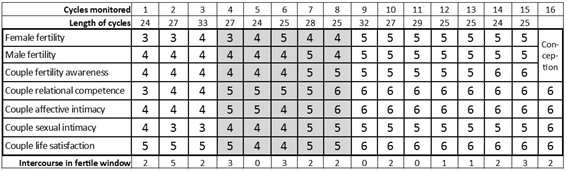
The bivariate log-linear analysis does not give statistically significant interaction effects. Various margin effects per cycle are significant: the first three decidedly negative (z = -4.533, p <.001; z = -4.533, p <.001; z = -3.958, p <.001). For the three subsequent cycles still negative effects but with less significance (z = -2.234, p <.05; z = -1.660, p <.05; z = -1.660, p <.05). The margin effects of cycles 7 and 8 are not statistically significant; those of cycles 9-13 are positive and significant (z = 2.888, p <.002). In cycle 14, the margin effect is highly significant (z = 3.45, p <.001). Therefore, the evolution of cycles appears divided into three bands: initial, intermediate (gray cycles in table 1), and final. It indicates a development towards a growth in levels of functionality. These analyses confirm what transpires from a direct check of the starting data table, however they offer precise indications of the cycles in which the evaluation changes of the dimensions appear.
The margin effects for size indicate significantly smaller variations for ‘Female fertility’ and ‘Sexual intimacy’: for both z = -2.53, p <.05. Significantly greater variations for Fertility awareness and for ‘Affective intimacy’: for both z = 3.12, p <.001.
All these results suggest that the 7 dimensions have a similar evolution over time and each with its own changes in functionality. They are useful information in verifying the accompaniment of the couple by the team.
Couple 2
-Male: age 40; education: upper middle school; profession: employee.
-Female: age 35; education: lower middle; profession: office worker.
-Couple history: married for 7 years, looking for a child for 24 months with unprotected sex. Subsequently, an informative meeting at an ART center and multiple medical consultations.
-Entering the FFP: the initial psycho-relational assessment highlights a positive understanding of the couple and high levels of female anxiety.
The FFP course monitors 14 cycles in the period from April 2018 to March 2020; at 15 months, natural conception has not been obtained. Size ratings are shown in Table 2.
Table 2. FFP path monitoring data for 14 cycles (Couple 2)
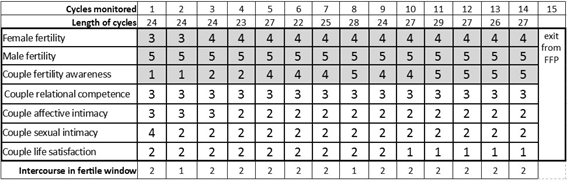
Margin effects per cycle are not statistically significant; significant and positive are the marginal effects of medical dimensions: ‘Female fertility’ (z = 7.49, p <.001), ‘Male fertility’ (z = 7.49, p <.001), and ‘Fertility awareness’ (z = 2.548, p <.01). In the psycho-relational dimensions, negative margin effects are for ‘Affective intimacy’ (z = -5.08, p <.001), ‘Sexual intimacy’ (z = -3.69, p <.01), and Life satisfaction (z = -9.69, p <.001). Interaction effects turn out to be some dimensions for some cycles: ‘Fertility awareness’ gives negative interaction effects in the first four cycles (respectively z = -4.15, p <.001; z = -3.88, p <.001; z = -2.41, p <.01; z = -2.11, p < .02) and positive in the last five (respectively z = 1.87, p <.05; z = 2.99, p <.001; z = 2.99, p <.001; z = 2.70, p <.01; z = 2.70, p <.01). ‘Affective intimacy’ shows a positive interaction effect only with the first three cycles (z = 2.37, p <.01; z = 2.75, p <.01; z = 1.96, p <.05): in the together, a path with low functionality. ‘Sexual intimacy’ highlights an evaluation error in cycle 1: substantially no change in functionality in the path ‘Life satisfaction’ shows positive interaction effects with the first two cycles (respectively, z = 1.65, p = <05; z = 1.98, p = <.02) and negative in the last four cycles (respectively, z = -1.77, p <05; z = -1.77, p <.05; z = -1.93, p <.05; z = -1.93, p <.05).
Largely, the effects of interaction with the psycho-relational dimensions indicate a worsening of functionality along the way. In the set of bivariate analyzes, the medical dimensions show an improvement (gray rows in table 2) and a worsening of psycho-relational ones, that clarify the reasons for the couple’s decision to close their parental research and ask for couple psychotherapy. So even if conception has not been achieved, couple has been helped in finding their specific path to work on their own psycho-relational dimension.
Final considerations
We analyzed the creation and the initial efforts in the implementation of a monitoring system, to develop a specific FFP QCP, for the multi-disciplinary diagnosis and treatment of couple infertility. Further studies are needed to better clarify the role of each studied variable in a complex monitoring system, involving multiple aspects.
In fact, although the primary expectation regarding the FFP service concerns the achievement of natural conception, since the planning stage of the service it became clear that other objectives are worthy of attention and commitment, since they are involved the relational maturity of the couples regarding their life project. The focus on alternatives to biological parenting and/or the reconstruction of psycho-relational competence, thus improving the conjugal intimacy of the spouses, are relevant objectives. In this work, some important variables of the process have been identified and we presented two illustrative cases: the first one in which a natural conception has been obtained and the second one, in which the focus has been moved from natural conception to the reconstruction of relational competence. Further studies will demonstrate, on large scale, the efficacy of our protocol and of the analyzed variables.
Declaration of conflicting interests
The authors declared no potential conflicts of interest with respect to the research, authorship, and/or publications of this article
References
Abrao, M. S., L. Muzii, and R. Marana. 2013. “Anatomical causes of female infertility and their management.” International Journal of Gynecology & Obstetrics, 123 Suppl 2: S18-24. Doi: 10.1016/j.ijgo.2013.09.008.
Agresti, A. 1990. Categorical data analysis. New York: Wiley.
Benazzi, F. 2019. “A multidisciplinary approach to health care.” In M. Cusinato and S. Girotto (eds.), Op. cit. IX-X.
Berardi, N. and A. Sale. 2018. Ambiente, plasticità e sviluppo cerebrale [Environment, plasticity and brain development]. Milano: Hachette.
Boivin, J., L. Bunting, J. A. Collins, and K. G. Nygren. 2007. “International estimates of infertility prevalence and treatment-seeking: potential need and demand for infertility medical care.” Human Reproduction, 28 (6): 1506-12. Doi: 10.1093/humrep/dem046.
Busato, E., M. Cusinato, W. Colesso, S. Gava, S., and S. Girotto. 2021. The case/care manager in service team for infertile couples: A pilot training program. In revision.
Carson, S. A. and A. N. Kallen. 2021. “Diagnosis and management of infertility: A review.” JAMA, 326, 65-76.
Cavasin, F. and U. De Conto. 2021. “The paradigm of integral human ecology in fertility management.” In M. Cusinato and S. Girotto (eds.), Op. cit., 77-90.
Colesso, W. And M. Cusinato. 2018. “Alexithymia and the relational competence of intimate relationships in regard to gender and age in a nonclinical population.” In R. J. Texeira, B. Bermond, and P. P. Moormann (Eds), Current developments in alexithymia. A cognitive and emotional deficit 73-106. New York: Nova Publishers.
Cusinato, M. 2021. “Gaining awareness of the role of fertility as a resource for the marital style of relational intimacy.” In M. Cusinato and S. Girotto, Op. cit. 91-106.
Cusinato, M., and W. Colesso. 2007. “Creazione e validazione di un modello di atteggiamenti childfree [Creation and validation of a model of child free attitudes].” Rivista di Studi Familiari, 1, 82-96. ISSN: 1972-5736.
Cusinato, M., W. Colesso, E. Busato, and S. Gava. 2021. “Monitoring the tuning of the «Fertile Family Path» service for overcoming gaps between desire, decision and conception.” Interdepartmental Journal of Family Studies, 26 (1): 1-13. Doi: 10.14658/IJFS-26-1.
Cusinato, M. and S. Girotto (eds.). 2021. Management of human fertility and infertility. A multidisciplinary approach. Torino: C.G. Edizioni Medico Scientifiche Srl. ISBN 978-88-7110-493-5.
D’Ippolito, S., Di Nicuolo, F., Pontecorvi, A., Gratta, M., Scambia, G., & Di Simone, N. 2018. “Endometrial microbes and microbiome: Recent insights on the inflammatory and immune “players” of the human endometrium.” American Journal of Reproductive Immunology, 80(6): e13065. Doi: 10.1111/aji.13065.
Dal Pozzo, G. and E. Dal Pozzo. 2021. “The relationship makes the difference: reflections on a 40-year experience as a hospital gynecologist.” In M. Cusinato and S. Girotto, op. cit. 53-64.
Deshpande, P.S. and A. S. Gupta. 2019. “Causes and prevalence of factors causing infertility in a public health facility.” Journal of Human Reproduction Science, 12, 287-293.
Doi, S. C. and M. H. Thelen. 1993. “The Fear-of-Intimacy Scale: Replication and extension.” Psychological Assessment, 5 (3), 377-383. https://doi.org/10.1037/1040-3590.5.3.377.
Donati, P. 2015. L’enigma della relazione [The enigma of the relationship]. Milano: Mimesis.
Forcolin, F. 2021. “Sexuality and affectivity in the multidisciplinary approach to the couple fertility problems.” In M. Cusinato and S. Girotto, Op. cit. 123-136.
Grande, G. 2021. “Diagnostic ow-chart and therapeutic perspectives for male factor infertility”. In M. Cusinato and S. Girotto, Op. cit. 11-22.
Grande, G., D. Milardi, F. Vincenzoni, G. Pompa, A. Biscione, A. L. Astorri, E. Fruscella, A. De Luca, I. Messana, M. Castagnola, and R. Marana. 2015. “Proteomic characterization of the qualitative and quantitative differences in cervical mucus composition during the menstrual cycle.” Molecular Biosystem, 11 (6): 1717-25. Doi: 10.1039/c5mb00071h.
Grande, G., F. Vincenzoni, D. Milardi, G. Pompa, D. Ricciardi, E. Fruscella, F. Mancini, A. Pontecorvi, A., M. Castagnola, and R. Marana. 2017. “Cervical mucus proteome in endometriosis.” Clinical Proteomics, 14: 7. Doi: 10.1186/s12014-017-9142-4.
L’Abate, L. 2012. “Hierarchical framework for relational competence theory.” In M. Cusinato and L. L’Abate (eds.). Advances in relational competence theory: With special attention to alexithymia pp. 13-48. New York: Nova Science Publishers. ISBN: 978-1-62100-599-5.
L’Abate, L. 2013. Beyond the systems paradigm emerging constructs in family and personality psychology. New York: Springer. Doi 10.1007/978-1-4614-7444-9.
L’Abate, L., M. Cusinato, E. Maino, W. Colesso, and C. Scilletta, C. 2010. Relational competence theory: Research and mental health applications. New York: Springer. ISBN: 978-1-4419-5665-1.
Marana, R., E. Busato, et al. (2021). Validazione empirica della Tavola “Fattori biologici negativi di fecondabilità” [Empirical validation of the table “Negative biological factors of fertility”]. Paper in progress.
Masoumi, S. Z., P. Parsa, N. Darvish, S. Mokhtari, M. Yavangi, and G. Roshanaei. 2015. “An epidemiologic survey on the causes of infertility in patients referred to infertility center in Fatemieh Hospital in Hamadan.” Iran Journal of Reproductive Medicin, 13, 513-516.
Meuleman, C., B. Vandenabeele, S. Fieuws, C. Spiessens, D. Timmerman, and T. D’Hooghe. 2008. “High prevalence of endometriosis in infertile women with normal ovulation and normospermic partners.” Fertility and Sterility, 92 (1): 68-74. Doi: 10.1016/j.fertnstert.2008.04.056.
Milardi, D. 2021. Male fertility and lifestyle. In M. Cusinato and S. Girotto, Op. cit. 171-178.
Morse J. L. and M. FR. Steger. 2019. “Giving birth to meaning: Understanding parenthood though the psychology of meaning in life.” In: Taubman Ben-Ari O. Pathways and barriers to parenthood 1-17. Cham (Swiss): Springer Nature Switzerland.
Moscatelli, M. 2013. La valutazione della qualità relazionale. Come cambiano le organizzazioni che investono sulle relazioni [The assessment of relational quality. How organizations that invest in relationships change]. Milano: V&P.
Obelenienė, B., A. Narbekovas, A. and J. Juškevičius. 2021. “Anthropological and methodological differences of natural family planning and fertility awareness-based methods.” Linacre Quaterly, 88 (1): 14-23. Doi: 10.1177/0024363919886517.
Oishi, S., E. Diener and R. E. Lucas. 2014. Subjective well-being: The science of happiness and life satisfaction. New York: Oxford University Press.
Peterson B. and J. M. S. Place. 2019, “The experience of infertility: An unexpected barrier in the transition to parenthood.” In O. Taubman Ben-Ari (Ed.), Pathways and barriers to parenthood 19-37. Cham: Springer Nature Switzerland. hpps//doi.org/10.1007978-3-030-24864-2_2.
Pope Francis. 2021. Address at opening of the general states of birth. Friday, 14 May 2021, Auditorium Conciliazione, Rome. http://www.vatican.va/content/francesco/en/speeches/2021/may/documents/papa-francesco_20210514_statigenerali-natalita.html (18/05/2021).
Ragusa, A. 2016-2021. Linee guida/Raccomandazioni [Guidelines / Recommendations]. AOGOI. https://www.aogoi.it/fondazione-confalonieri-ragonese/linee-guida/
Rotterdam ESHRE/ASRM-Sponsored PCOS Consensus Workshop Group. 2004. “Revised 2003 consensus on diagnostic criteria and long-term health risks related to polycystic ovary syndrome.” Fertility and Sterility, 81, 19-25.
Ryff, C. D. and B. H. Singer. 2008. “Know thyself and become what you are: A eudaimonic approach to psychological well-being.” Journal of Happiness Studies, 9, 13-39. Doi: 10.1007/s10902-006-9019-0.
Rumbold, A.R., Sevoyan, A., Oswald, T.K., Fernandez, R.C., Davies, M.J., Moore, V.M. 2019. Impact of male factor infertility on offspring health and development. Fert Steril. 111(6):1047-1053. doi: 10.1016/j.fertnstert.2019.05.006.